
Engineer Wei
21 авг. 2026 г.
From real-world samples to process validation — bringing laboratory coating closer to practical applications
From real-world samples to process validation — bringing laboratory coating closer to practical applications
For conventional flat samples, film thickness and coating coverage in magnetron sputtering are relatively easy to control.
However, the situation becomes much more challenging for spherical, cylindrical, and other complex 3D components. Differences in angle, distance, and geometric shadowing between different surface areas and the target can lead to uneven deposition under static coating conditions, with sufficient deposition on the front side but limited coverage on the sides and rear surfaces.
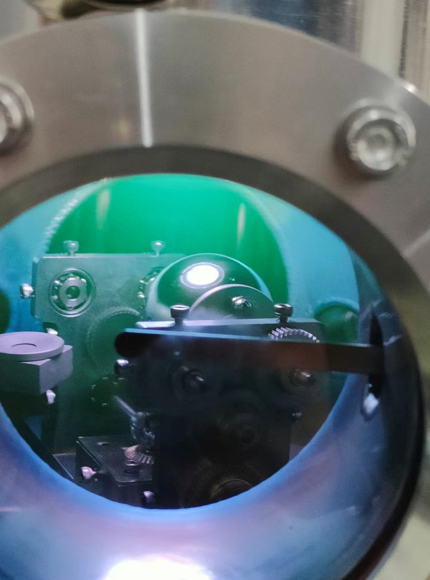
To address this application challenge, VPI carried out a titanium thin-film deposition test on a complex spherical metal component using a high-vacuum magnetron sputtering system combined with a 360° rotating sample stage.
The results show that an appropriate vacuum environment, controlled magnetron sputtering conditions, and continuous sample rotation can effectively improve coating coverage on complex curved surfaces. This provides a practical approach for surface functionalization of 3D components in scientific research and industrial R&D.
Starting from a Real-World Sample
In this test, a stainless-steel spherical component with a diameter of several tens of millimeters was used as the substrate, and a Ti thin film in the hundreds-of-nanometers range was deposited by magnetron sputtering.
Compared with conventional silicon wafers, glass substrates, or flat metal samples, a spherical structure better reflects the technical challenges encountered when coating real components.
The key question was not simply:
“Can a Ti film be deposited?”
More importantly, the test aimed to verify:
“Can better overall coverage be achieved on a complex 3D surface?”
This is also one of the key issues VPI focuses on in real customer applications.
Core Solution: High Vacuum + Magnetron Sputtering + 360° Rotation
This application used a VPI high-vacuum magnetron sputtering coating system.
During the process, stable high-vacuum conditions and high-purity process gas were used to establish the sputtering environment, while DC magnetron sputtering was applied for Ti film deposition.
The most important process design was:
Continuous 360° sample rotation
If a spherical sample remains stationary, the area facing the target receives more deposition, while the rear side is more strongly affected by geometric shadowing. Under static sputtering conditions, the coating on the rear curved surface can therefore become significantly thinner.
With continuous rotation:
Front → Side → Rear → Opposite Side
Different areas of the sample periodically enter the effective deposition zone, improving the average exposure of the entire spherical surface to sputtered particles.
For complex components, sample motion therefore becomes one of the key factors affecting coating uniformity.

A Complete Process — Not Just a Single Sputtering Step
A stable thin-film process does not begin only when the sputtering power is switched on.
In this project, the sample first underwent surface pretreatment to reduce the influence of oil, dust, and other surface contamination on the coating process. The sample was then loaded into the vacuum chamber, the rotation mechanism was activated, and stable vacuum and process-gas conditions were established.
The overall process can be summarized as:
Sample CleaningSurface pretreatment
↓
Sample LoadingSample mounting
↓
High VacuumEstablishing a high-vacuum environment
↓
360° RotationActivating continuous sample rotation
↓
Magnetron SputteringThin-film deposition
↓
Cooling & VerificationCooling and result verification
Stable thin-film performance ultimately depends on the combined effect of:
Sample condition + Vacuum environment + Process atmosphere + Sputtering parameters + Sample motion
Test Results: Improved Overall Coverage on a Complex Spherical Surface
After the deposition process, the resulting film thickness met the expected requirement.
The test also showed that 360° rotation allowed different areas of the spherical component to periodically receive Ti particle flux. Combined with particle scattering in the process atmosphere, this further improved the film-thickness distribution over the curved surface.
This means that:
Complex 3D samples are not limited to one-sided deposition.
Through proper sample-motion design and magnetron sputtering process control, laboratory vacuum coating can be extended to a much broader range of real-world components.
This also highlights the importance of:
Sample mounting, sample motion, and coating-process design.
The spherical-component test is a representative example of how VPI is extending vacuum coating from conventional laboratory samples toward real application-oriented components.
Typical Application Areas
This process concept can be further applied to a wide range of 3D samples and surface-engineering R&D, including:
Surface functionalization of precision components
Metal thin-film deposition on complex curved surfaces
Metallization of sensors and devices
Thin-film research on optical fibers and cylindrical structures
Development of advanced materials and functional coatings
New process validation in industrial R&D laboratories
Vacuum Coating Solutions for Advanced Materials
Starting from real-world samples, VPI brings vacuum coating closer to practical research and application.